
Supply Chain Management Software Cost in 2025
If you’re researching the cost of supply chain management software, you’re not alone. Businesses everywhere are trying to understand how much they should budget for SCM systems in 2025.

Content Map
More chaptersBuilding a supply chain management system from scratch or selecting which off-the-shelf solutions to use is now driven not just by preference but also by budget constraints. In other words, how much you’re willing to spend on an SCM tool really shapes your choices down the line.
However, like any other type of software development, the supply chain management software cost is not always straightforward and fluctuates more or less depending on many different factors. The cost can range from a few dollars per month to hundreds of thousands of dollars.
In this article, we break down everything you need to know, including:
- The key factors that affect SCM software cost
- How much it costs to build a custom supply chain management system
- Real pricing examples from popular SCM solutions
By the end, you will have a clear picture of what supply chain software really costs and how to choose the best option for your business.
Key Factors Affecting SCM Software Cost
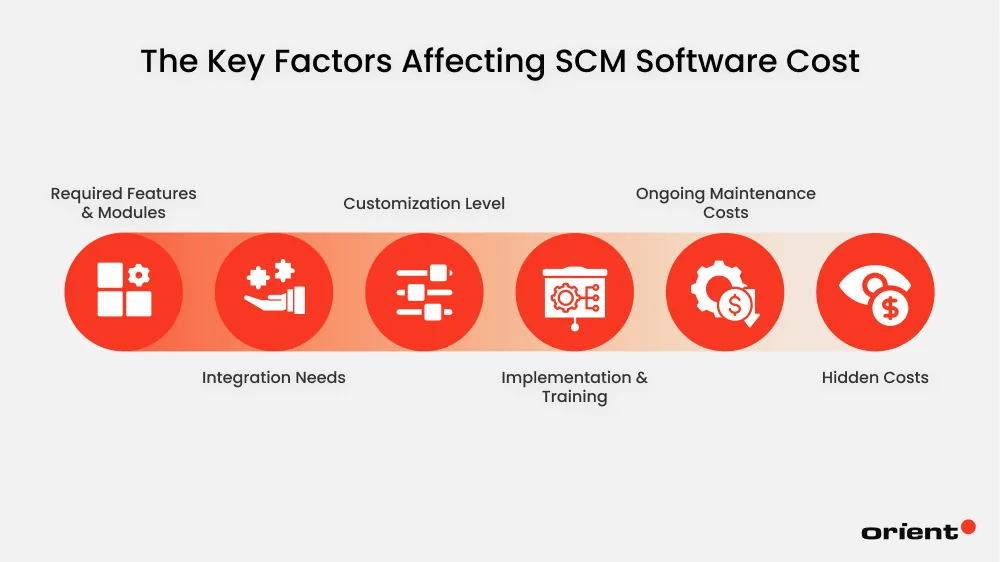
Supply chain management software has become essential for businesses that want to reduce costs, improve efficiency, and keep up with customer demand. But one of the biggest questions companies ask is: “How much does supply chain management software cost?” As mentioned earlier, to obtain the most accurate number for supply chain management software price, it’s helpful to think about all the factors that could influence your decision, whether big or small. Curious about what they are?
Required Features & Modules
Different companies have varying levels of complexity. For instance, a small retailer usually cares mostly about straightforward inventory tracking, making things simpler and easier. On the other hand, a large manufacturer might need more robust features, such as advanced analytics, demand forecasting, risk management, enterprise resource planning, supply chain analytics, supply chain planning, and multi-location visibility. Understanding these differences helps in choosing the right solutions to meet each company’s unique needs.
The point is, the number of modules and the complexity of the features have a significant impact on the final cost. Most SCM solutions are modular, meaning you only pay for what you use. The more features and modules your business needs, the higher the cost of SCM software. And of course, complex modules (like warehouse automation or AI forecasting) require advanced systems, which naturally cost more in return. However, in some cases, many basic features are worth just one advanced feature. This modular flexibility is why SCM software can be affordable for small businesses but also powerful and expensive for global enterprises.
Integration Needs
As technology networks continue to evolve, seamless integration has become a necessity for software operations. However, integration costs are often underestimated until implementation begins because businesses don’t fully understand how much work is required to make different systems connect and communicate smoothly. More than simply syncing data back and forth between applications, integrating involves a bunch of different things, such as technical complexity, compatibility checks, workflow mapping, data cleaning, testing, and ongoing maintenance.
Normally, the common systems SCM software integrates with include:
- Enterprise Resource Planning (ERP) systems (SAP, Oracle, Microsoft Dynamics)
- Customer Relationship Management (CRM) tools (Salesforce, Zoho CRM)
- Accounting software (QuickBooks, Xero)
- E-commerce platforms (Shopify, WooCommerce, Amazon, eBay)
- Warehouse technology (barcode/RFID scanners, IoT devices)
- Transportation and logistics systems
- Manufacturing software (MES, MRP)
A supply chain management tool can be linked to one or more applications, depending on the needs of a particular business. The more systems your business uses, and the more deeply you want them connected, the higher the cost will be. Companies with simple setups may spend very little on integrations, while businesses with complex IT environments must invest significantly more. This is why large-scale systems often result in higher integration costs.
Customization Level
Customization level is one of the factors that most strongly affects the overall supply chain app development cost. Rather than choice, customization is sometimes an unavoidable factor that gives one business the opportunity to gain a competitive advantage and achieve specific workflows. And of course, the moment you move beyond the software’s standard settings, the cost begins to change. Basic adjustments will be more affordable than advanced or unique customizations, which can significantly increase project costs by double.
Adjusting labels or terminology, or adding a few extra data fields, are considered light customizations. Meanwhile, developing complex forecasting models or connecting to proprietary systems are deep customizations that always add time, complexity, and long-term maintenance needs.
Implementation & Training
Buying or deploying supply chain management software is only the first step. Before putting it into practice, the systems need to be properly implemented: configured, tested, connected, and aligned with your workflows to ensure everything is fully ready for daily operations. Depending on the complexity of your entire supply chain, this process can be quick and simple or lengthy and intensive. For a small retailer that only owns a warehouse with simple inventory flow, implementation only takes a few days and incurs low costs. For large manufacturers that own robotic systems or multiple supply chain partners, such a process can last for months or even years, resulting in higher implementation costs.
Plus, it’s important to give your team clear instructions on how to use any application before you send it their way. Even the best SCM software fails if people don’t know how to use it. Training activities come into play, and, of course, organizing them isn’t free. In some cases, companies do not have experts in teaching or implementation, and hiring a software vendor or implementation partner also incurs costs.
Ongoing Maintenance Costs
Most companies focus heavily on the initial price of SCM software, including licenses, setup fees, integrations, and customization. However, the real cost of owning a supply chain management system becomes apparent later, in the form of ongoing maintenance and support. Every modern SCM platform, whether cloud-based or on-premise, requires continuous support to keep everything running smoothly. If you just deploy the software and leave it to run, over time, the system can slow down, become outdated, and even face serious operational issues. Keep in mind, these long-term maintenance costs can surprise many teams and add up more than you might expect, affecting your overall budget.
There are many things businesses need to do to ensure operational efficiency. Ongoing maintenance costs can come from basic activities such as software upgrades and technical support, to more advanced tasks such as data management and network security. Note that if a business chooses to use SaaS solutions instead of developing in-house, ongoing maintenance costs will be the responsibility of the vendors. Otherwise, you will need to pay a monthly or yearly subscription to keep your service running smoothly and maintain supply chain efficiency. The typical range will be from $100 to over $5,000 a month, depending on size.
Hidden or Often Overlooked Costs
Additional expenses are inevitable. As you can’t predict the future, no matter how carefully you budget, unforeseen costs will eventually arise when you least anticipate them.
- Data migration and cleansing: Moving existing data into your new SCM system - inventory lists, SKUs, supplier records, purchase history, warehouse locations - sounds simple, but it’s rarely straightforward. For the migration process to go smoothly, data must be cleaned, duplicates removed, and processed in fixed formats. The more data you have, the tougher the migration.
- Third-party plugins: Many SCM tools rely on third-party apps (accounting connectors, shipping rate calculators, analytics dashboards) to extend functionality, especially SaaS systems. These plugins often come with separate subscription fees that stack up over time.
- API limitations: Many vendors include API access, but limit how much you can use it. If your supply chain needs frequent real-time updates (e.g., warehouse movements, e-commerce orders), you may quickly exceed the base API limits and face higher-tier charges.
- Additional modules: Companies often start with a small set of features but expand over time as the business grows. SCM systems are modular, and the base price rarely includes everything a growing business eventually needs. The more features that are added, the higher the cost becomes.
- Contract renewal: If you use third-party supply chain management, contract renewal costs are significant. Many SaaS vendors offer attractive introductory pricing, but renewal terms are often higher. This happens because business usage grows over time, and promotional discounts become outdated and expire, leading to a 5%-15% price increase.
Cost to Build a Custom Supply Chain Management Software
We already know what factors affect the price. However, the question is: “How much does it cost to build supply chain management software?”. With thorough research based on information collected from multiple sources on Google, here we provide you with an estimated cost for supply chain optimization software. Since each business has different sizes and needs, the specific number can only be determined by the business owner, development team, and analysts.
| Complexity Level | Typical Company Profile | Estimated build cost (USD) |
|---|---|---|
| Basic/MVP SCM | Small retailer, D2C brand, early-stage startup | $10,000 - $30,000 |
| Mid-Complexity SCM | Growing distributors, mid-size manufacturers, 2-5 warehouses | $40,000 - $150,000 |
| Enterprise SCM | National or regional enterprise, complex supply chain, multiple business units | $150,000 - $600,000 |
| Global/AI Heavy SCM | Global brands, regulated industries (pharma, aerospace, FMCG), cross-border logistics | $600,000 - $1,500,000+ |
Cost to Use Existing SCM Software on the Market
If you are not ready to build your own supply chain management software, the next logical step is to look at existing solutions on the market. There are hundreds of supply chain software tools available today, each with its own pricing model. Some charge per user, some charge per module, and some require a long-term contract. To help you choose exactly what you want at the right cost, here’s a clear breakdown of what you will typically pay for the most common solutions on the market.
The Cost Range of Cloud-Based SCM Solutions (SaaS)
Similar to how you pay for Netflix or Spotify monthly or annually, cloud-based supply chain management software requires users to pay a subscription fee to use its services. There’s no need to download or install anything on your server; just log in through your web browser, and you’re all set to access all the features SaaS has to offer.
What You Pay for:
- Monthly or annual subscription
- Usually charged per user or per module
- Sometimes extra fees for support or integrations
Typical Cost Range:
- $30 - $300 per user per month
- Enterprise platforms may cost more
Who This Is Best for:
- Small to medium businesses
- Companies that want a fast setup
- Businesses without a large IT team
Below are some popular SaaS offerings and information about their pricing models:
| Cloud-Based Solutions | Starting Price |
|---|---|
| SAP Integrated Business Planning (SAP IBP) | ~$230/user/month |
| Oracle SCM Cloud | ~$150 - $300/user/month (varies by module) |
| Infor Nexus | Custom quote |
| Blue Yonder Luminate | ~$150 - $250/user/month |
| Zoho Inventory | $39 - $249/month (flat rate, not per user) |
| Manhattan Associates (Cloud WMS/TMS) | ~$20,000 - $60,000/year (subscription contract) |
| Fishbowl Inventory | ~$4,395 one-time + optional subscription for updates/support |
The Cost Range of On-Premise SCM Solutions
On-premise supply chain software is a solution installed directly on your company’s servers, not online. Because it is integrated directly into your servers, your business owns the software license and is responsible for managing everything related to the solution, such as servers, security, backups, updates, and technical maintenance. An internal IT team is needed to streamline the supply chain operations. Although requiring a lot of management effort, on-premise systems offer a high level of flexibility and customization.
What You Pay for:
- A one-time license fee
- Hardware (servers)
- Installation
- IT staff
- Maintenance contracts (yearly fee)
Typical Cost Range:
- $25,000 - $500,000 + upfront costs
- Annual maintenance is 18-25% of the license cost
Who This Is Best for:
- Large enterprises
- Companies needing heavy customization
- Businesses with strict security requirements
| On-Premise Solutions | Cost Range |
|---|---|
| SAP SCM (traditional on-prem) | Licensing cost: $10,000 - $300,000+ depending on modules Hardware + IT: $20,000 - $100,000 Annual maintenance: ~18-22% of license cost |
| Manhattan SCALE (on-premise WMS) | Licensing cost: ~$100,000 - $500,000+ Hardware + IT: Typically $50,000+ Annual maintenance: 18-22% of license cost |
| Traditional On-Premise WMS/TMS Tools | Licensing cost: $25,000 - $200,000 Additional costs: Hardware, installation, IT personnel Annual maintenance: 15-25% of license cost |
Is It Worth Investing in Supply Chain Management Software?

The answer is yes. More than just a technological upgrade, investing in any kind of supply chain solution is a strategic move that directly impacts business performance and long-term growth. Not only does it help businesses automate inventory management or demand planning based on real-time data, but the software also plays a major role in managing supplier relationships and maintaining customer satisfaction.
The initial investment cost for bespoke supply chain management software is higher than that of off-the-shelf solutions. However, it is a smart choice in the long term to optimize supply chain performance. Instead of asking “How much does supply chain management software cost?”, ask “What real value does this investment bring to you?”.
If supply chain management software development or supply chain management software integration is what you are looking for, contact Orient Software to receive support from experts. With 20 years of experience in the technology field, we can help you form an expert team within just two working weeks and immediately create measurable results.