Exploring Python Alternatives: Choose the Right Language for Your Project
Python can’t be the answer to every problem, no matter how popular it is. Sometimes, the right tool for the job lives outside the Python ecosystem.

Content Map
More chaptersPython has long proven to be a versatile and dominating programming language. However, as technology develops in leaps and bounds, developers are looking for Python alternatives. This is not to say that the programming language has become obsolete or irrelevant; it simply highlights the fact that Python isn’t always the suitable choice for specific projects. Other technologies may be a better fit to achieve a project’s specific goal. With this in mind, this article will discuss Python alternatives, why they might be a better choice, and how to pick a tech that best fits your needs.
Key Takeaways:
- Python is a versatile language that can fit into almost every project, but it does have limitations that might lead a developer to choose another language.
- Limitations for Python include:
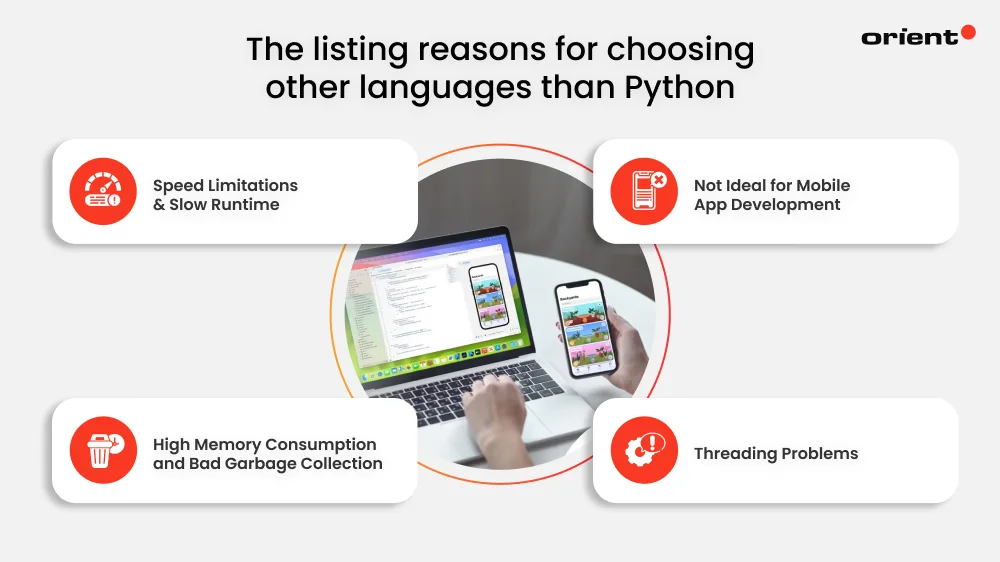
- Slow runtime and speed limitations
- A weak language when it comes to mobile app development
- High memory consumption
- Multithreading problems
- Depending on specific project requirements (web development, speed, strong security, etc.), JavaScript, Ruby, Go, PHP, and Rust are among the top Python alternatives.
Why Developers Look for Python Alternatives
Python holds an important position in the developer’s world for numerous reasons: it is easy to learn, can be a great fit for any project size, and can be used to develop mobile apps, web apps, and even AI programs.
This, however, doesn’t mean Python is a perfect language. There are still some drawbacks that developers need to be aware of, as they might play a role in determining whether the language is the most optimal choice for the project.
Speed Limitations & Slow Runtime
Python, an interpreted language, is slower compared to compiled languages like Java or C++. The main reason behind this is that:
- Python is a high-level programming language, which means the execution of Python code takes place with the help of an interpreter.
- Its code is executed one line at a time, slowing down the runtime.
- In compiled languages like Java, the code is converted into machine code, speeding up the execution speed significantly.
The slower speed may not be significant in the case of smaller datasets or simple calculations. But when the scale is larger, or the tasks get more complicated, the difference can be quite noticeable.
In short, if speed and performance are among your top priorities, you might want to consider other tools other than Python.
Not Ideal for Mobile App Development
Python is generally a powerful language for desktop apps and server platforms, but it is often considered a weak language for mobile development. The language’s GUI frameworks are not a natural fit for mobile devices. This is not to say that Python can never be part of a mobile app development project. With external frameworks like Kivy and Beeware, it is possible to adapt Python’s codebase to Android or iOS platforms.
High Memory Consumption and Bad Garbage Collection
Memory management is crucial for every application. Efficient memory management is how one ensures the application is stable, has enough resources to function well, and there are no unexpected crashes or shutdowns.
Python is optimized for easy development. However, this also means there is a lot more memory overhead. For starters, it stores a lot of extra information with every value. Since Python is dynamically typed, each number or string carries metadata about its type and usage, which makes it easier for the interpreter to work with, but increases memory costs. Python’s built-in structures like lists and dictionaries also over-allocate space to stay fast and flexible, and Python’s automatic memory management (reference counting and garbage collection) adds additional overhead. All of this makes Python very convenient to write, but naturally more memory-hungry than lower-level languages like C, Go, or Rust.
Threading Problems
In theory, Python can run multiple threads, even though this isn’t its strongest feat, especially when you consider CPU-heavy workloads. The culprit behind this is the Global Interpreter Lock (GIL), a built-in mechanism that lets only one thread run Python code at a time. Python can’t take full advantage of the machine’s multiple cores, especially when there are heavy processing tasks.
With all this being said, it’s crucial to keep in mind that Python’s drawbacks aren’t completely unsolvable. With a little extra effort, most problems wouldn’t negatively affect the development process much. Take multithreading problems, for example. Python isn’t always poor at multitasking. The language can still handle I/O-bound tasks well since threads can take turns efficiently while they wait.
Still, being aware of Python’s drawbacks allows developers to plan and select a programming language that best works for the project’s requirements and the team’s available experiences.
Top Python Alternatives and When to Use Them
JavaScript: Web Powerhouse
JavaScript can be considered a top alternative to Python. The language shares some of Python’s core features: easy to learn and read, dynamically typed, boasting a large ecosystem, and sharing the core strength of machine learning and data science.
JavaScript, on its own, is primarily a front-end language designed for interactive websites. With Node.js, a runtime that allows JavaScript to operate on servers and other environments, the language’s capabilities expand significantly. This combination enables JavaScript to act as a powerful, end-to-end development stack and a strong alternative to Python.
Node.js shines most in real-time workloads like chat apps, streaming, and live collaboration tools that all lean on its event-driven model to handle huge numbers of simultaneous connections. Platforms like Netflix and LinkedIn rely on Node.js. It also fits naturally with APIs and microservices, especially when teams want shared logic across frontend and backend frameworks like React or Vue.
What really sets Node.js apart is its architecture. The event loop avoids Python’s GIL limits and handles far more I/O-heavy requests. And while both languages use dynamic typing, V8’s JIT engine gives Node.js a clear performance edge, often 2 to 4 times faster in common web service workloads.
In short, JavaScript with Node.js runtime outperforms Python in the following cases:
- Apps with real-time features like streaming or live updates
- A single language that provides full-stack development
- Frontend and backend sharing code
- Integration with a JavaScript frontend framework
Ruby: Rapid Web Development with Improved DX
Simplicity and readability are two main features that Ruby shares with Python. Regarding similar technical aspects, Ruby and Python are both high-level interpreted languages, though Ruby performs tasks slightly faster. A clear advantage Ruby has over Python is metaprogramming: it has the powerful ability to modify classes and methods while the program is running, which gives Rails its flexibility but can make debugging harder.
Ruby is a great choice when your team wants to build MVPs, and the project prioritizes fast iterations over raw performance. DevOps is another of Ruby’s strong points: tools like Chef and Puppet are Ruby-based because the language works well for automation and system scripts.
A big part of Ruby’s appeal comes from Ruby on Rails. Rails is built for fast, modern web development and follows “convention over configuration,” meaning developers spend less time setting things up and more time building actual features. This makes Ruby a great fit for teams that want to ship quickly without sacrificing clarity in their code.
In short, you might want to consider Ruby over Python when:
- You’re working within an existing Ruby or Rails ecosystem.
- You’re building web apps and want to rely on Rails’ built-in conventions.
- Developer speed and overall workflow experience matter to you.
- You value Ruby’s flexible metaprogramming, even if it isn’t the fastest option.
- You prefer Ruby’s more consistent, object-oriented approach.
Go: Speed and Simplicity
Go, or Golang, is a programming language created by Google. It was designed with concurrent functionalities and memory efficiency in mind.
Unlike Python, Go is not an interpreted language. That core difference shapes what Go is best at, and why many developers see it as a strong alternative for high-traffic, cloud-first systems.
If you are prioritizing speed and efficiency, Golang is a strong contender. Google has built Golang to handle what Python struggles with: fast start, seamless handling of multiple tasks at a time, and easy deployment. It is a great tool for building reliable systems.
Go’s strengths lie in cloud infrastructures and microservices. Well-known tools like Kubernetes or Docker are run on Go since this language can handle heavy traffic with little resource usage. Other great use cases of Go are command-line tools, APIs, and data pipelines where performance matters more than flexibility, which is one of Python’s strong points.
Last but not least, Go’s ability to handle massive concurrency lets you run thousands of tasks at once without slowing down the system. Its programs compile down to a single file, which keeps the file lightweight and running extremely fast.
In short, choose Go for:
- Command-line tools with simple distribution
- Microservices
- High-performing APIs and web services
- Concurrent processing
PHP: Web Classic That Still Delivers

PHP is a server-side scripting language that is open-source and mostly used for web development. This is why it’s a practical Python alternative, especially if your team is working on a web development project. Even though PHP was initially a language focusing on web development, frameworks like Laravel and Symfony have expanded its capabilities and what you can build with it. PHP remains a popular language, powering well-known platforms like WordPress and other e-commerce systems.
Regarding the technical aspect, PHP is known for being straightforward, beginner-friendly, and boasting a large community support. You can directly embed it into HTML, deploy it easily on almost every hosting service, and handle command-line scripts. When it comes to web tasks, PHP is often much faster or even beats Python’s speed.
In short, PHP is a top choice if:
- Your team is already well-versed in PHP
- Your project involves customizing or developing WordPress sites
- You have a traditional web with server-rendered pages
- You want cheap shared hosting.
Rust: Safe and Super-Fast
Rust was created by Mozilla. It is a modern, high-performance systems programming language, delivering performance close to C/C++ while preventing common bugs like crashes or memory leaks.
If you want to solve performance bottlenecks in Python, Rust is a great replacement. It can be used to build high-concurrency, low-latency systems. It is present in WebAssembly, systems programming, high-performing backends, and blockchain projects – where security and efficiency are high priorities.
What sets Rust apart is its strict compile-time checks, which catch issues early and lead to predictable, stable software. The trade-off for this is its steep learning curve compared to Python. However, once developers are used to the language, the effort is worth it.
Rust is a great choice for top-tier performance and long-term stability. In more detail, it’s also great for:
- CPU-intensive workloads
- WebAssembly modules
- Guaranteed memory safety requirements
- Embedded systems
- Bare-metal programming
Kotlin: Modern and Versatile
Kotlin is a modern, statically typed general-purpose programming language that runs on the Java Virtual Machine (JVM). Developed by JetBrains, Kotlin offers many perks, especially if your team is already working within the Java ecosystem. The language’s advantages include:
- Concise, expressive syntax that’s less boilerplate than Java
- Seamlessly working with Java libraries.
- Robust tooling and type safety make code less prone to runtime errors.
- Kotlin is the preferred language for Android development, so it is a default choice for mobile projects.
- The language is also highly valued for backend web services and cross-platform app development thanks to Kotlin Multiplatform.
The appeal of Kotlin lies in its simplicity, performance, security, and flexibility. It is a recommended choice over Python when:
- You build an Android app.
- Want Java’s performance, but with a more modern syntax.
- You want to use Kotlin Multiplatform to build cross-platform mobile apps.
- You already work within the JVM infrastructure.
Dart: Built for Cross-Platform Apps
If you are interested in cross-platform development, Dart is a solid alternative to Python. Created by Google, Dart powers the Flutter framework, which is now one of the most popular ways to build mobile, web, and desktop apps from a single codebase.
Dart was created in 2011 as a potential JavaScript replacement, but Flutter’s rise in 2018 has completely changed this plan. Most developers today use Dart specifically for Flutter mobile development, especially when they want a single codebase for both iOS and Android apps.
Technical strongpoints of this language are strong static typing, built-in async support, and both JIT and AOT compilation. These features create fast development cycles, hot reload during coding, and native-level performance.
Go for Dart when you:
- Build iOS and Android apps with Flutter
- Cross-platform UI development using a single codebase
- Projects that need native performance without writing Swift/Kotlin
Julia: Made for Math & Science
Julia is a dynamic, high-level, high-performance programming language created especially for scientific and numerical computation. Julia is a strong Python replacement if your work leans towards numerical analysis, scientific computing, or AI research.
It was introduced in 2012 to solve the “two-language problem”. Julia aims to give developers both Python-style readability and C-level performance (instead of prototyping in Python or MATLAB, then rewriting in C for speed).
It uses just-in-time (JIT) compilation to generate fast machine code through LLVM. The tradeoff: the first run of a function can feel slow due to compilation, but everything after that runs extremely fast, often 10 to 100 times faster than equivalent Python numerical code. This makes Julia ideal for performance-critical workloads where Python’s interpreted design becomes a bottleneck.
In short, don’t hesitate to go for Julia when:
- The project involves numerical analysis, scientific computing, and high-performance research
- Computational physics
- Algorithmic trading
- Quantitative finance
- Differential equations, simulations, climate modeling, etc.
Tips for Choosing the Right Programming Language
Selecting the right language for the job is one of the first questions one might need to ask, and it also might be the hardest. Worry not. As long as you keep these tips in mind, choosing a programming language doesn’t have to be so much of a hassle.
- The kind of product you’re working on, whether it is a web app, mobile app, or enterprise software, shapes the language that works well for the project. Python or JavaScript is often flexible enough to fit almost anywhere. Others, for example, may only fit specific types of projects.
- Scalability depends on the overall tech stack, but performance alone is closely related to the language you choose. Some languages handle heavy workloads better.
- Think about your team’s experience. The past projects your developers have worked on determine the comfort level and language that is most practical for the next product.
- Always think of security from the very early stages. Some industries might require strict industry regulations (like HIPAA in the medical field), so make sure you double-check regulatory compliance.
- Take the timeline into consideration, and how fast you want to have an MVP ready. Some languages let teams build and iterate faster than others.
- What are clients’ expectations when it comes to handling large datasets or real-time interactions? Some programming languages can handle these aspects faster than others.
- A language is more than just syntax – it comes with an ecosystem. Look at library support, update frequency, and long-term reliability. You want a language that will continue to evolve, not one that becomes a maintenance headache later.
Final Thoughts
There are multiple alternatives to Python for one to choose from. Depending on specific project requirements, the team’s experience, and the project’s deadline, you can choose a language that works best for you. If you are still unsure how to navigate the maze of programming languages, let a credible professional like Orient Software help you. Contact us today to gain valuable insights not only into programming languages, but also into every other aspect of a software development project to bring your visions into reality!

Quynh Pham
Writer
Quynh Pham
Writer
Topic: