Shedding Light on How the IT Outstaffing Model Works
This guide will help you understand the IT outstaffing model and know how to distinguish it from other outsourcing arrangements.
Content Map
More chaptersHave you heard of IT outstaffing and wonder what it is? Is it just another word for outsourcing? Not quite. Basically, anything that involves seeking support or resources from an external party rather than relying on in-house capabilities is generally considered outsourcing. By that logic, outstaffing seems to fall under the same umbrella, doesn’t it? Well, yes, but the relationship is not that straightforward once we delve into specifics. The line between outsourcing and outstaffing often blurs.
While both terms are applicable in the IT industry, they represent distinct approaches that revolve around leveraging external resources. Also, the dynamics of control, collaboration, and responsibility set them apart, not to mention the fact that outstaffing is less common than the other. This confusion is understandable. So, let’s clear it up by exploring how IT outstaffing differs from software development outsourcing in practice.
Key Takeaways:
- Outstaffing Model Explained: It is a flexible team extension model where external professionals are employed by a provider. They work as part of your internal team, following your processes and direction.
- Variants of Outstaffing: Includes individual outstaffing (hiring single specialists), dedicated team models (complete teams managed by the client), and options based on geography (onshore, nearshore, or offshore).
- Core Benefits: Outstaffing offers cost savings of up to 30 - 60%, faster hiring and onboarding, access to global top-tier talent, flexible and scalable team structures, full managerial control, and relief from HR and administrative burdens, all while maintaining alignment and quality.
- A brief comparison of outstaffing and outsourcing:
- Similarities: Both outsourcing and outstaffing enable businesses to leverage third-party expertise, reduce costs, fill talent gaps, and accelerate development without expanding internal headcount.
- Differences: Outsourcing is a pay-for-results model focused on deliverables managed by the vendor, while outstaffing is a pay-for-talent model where clients retain control over external professionals who operate as part of their internal team.
What Is an Outstaffing Model?
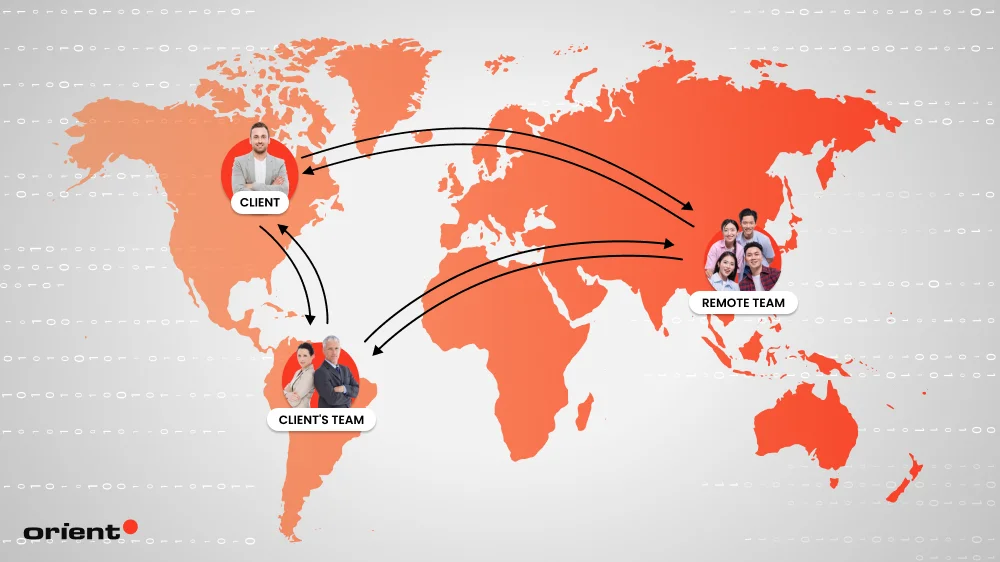
In the IT industry, the outstaffing or out-staffing model refers to a form of external employment (Onshore, nearshore, or offshore) or team extension where a company hires developers or an entire team via a third-party provider.

By nature, these professionals are officially employed and managed by the outstaffing company, but they operate under the direct supervision of the client, dedicating themselves to one specific client’s project and following its processes and objectives. When outstaffing, you delegate the HR and admin burden to the external team while still having control over the day-to-day tasks, project assignment, and integration.
Sometimes, this arrangement is also referred to as “staff augmentation, offshoring, or extended team.” Like other business models regarding outsourcing, the outstaffing model comes with variants that adapt to various business needs and suit different scopes, locations, and structures of each client company.
Individual Outstaffing

This is the simplest yet most common form. A company hires new team members to fill missing skill gaps within its existing team. The outstaffing provider supplies vetted professionals who have the specialized skills the company’s team is lacking. For example, a startup might bring in a single DevOps engineer or UI/UX designer through an outstaffing provider for a defined project. This on-demand outstaffing model is suitable for projects or businesses with short-term needs, budget constraints, rapid scaling, or supplementing niche expertise without long-term commitment.
Dedicated Team Model

The service provider assembles a complete, self-contained team including skilled professionals who have the required technical expertise and are dedicated solely to one client. The additional IT specialists work alongside internal teams of your own company.
An outsourced development team consists of different roles, ranging from developers, QA engineers, and testers to designers and sometimes project managers, based on the requirements of the client company. As service users, you have direct management over the squad of skilled developers and their performance, while the provider takes care of all the overhead, namely recruitment, vetting, onboarding, and HR administrative aspects of hiring full-time employees. This flexible staffing solution enables you to scale up or down the outstaffed team to match your requirements over time.
What Benefits Can You Expect from IT Outstaffing Services?
It is no secret that outsourcing software development can offer many advantages compared to in-house development. Outstaffing promises the twin perks of cost-effectiveness, flexibility, and more. Let’s find out.
Trim Costs to the Fullest
The first and foremost advantage must be cost-saving and budget optimization.
This is indeed a major plus, especially in a fiercely competitive tech industry, where seasoned professionals are not only highly sought after but also expensive to employ. Usually, senior specialists command staggeringly high salaries for their expertise, not to mention high-demand areas like artificial intelligence, blockchain, and big data. This poses a significant financial challenge for many businesses and projects looking to build an IT project team.

Fortunately, with outstaffing, you can extend your reach beyond regional boundaries and capitalize on global wage differences. You no longer need to bear overhead costs. Through a service provider, you can connect with remote professionals who offer lower labor rates while still providing the same technical know-how and skill level that might be hard to find or locally unaffordable. A rough estimate indicates that businesses can typically save 30% to 60% compared to local hiring.
Moreover, outstaffing vendors handle many of the overhead expenses associated with employment and business operations, such as benefits, salaries, office space, taxes, training, and all the equipment. You are released from administrative burdens.
Whether you’re hiring offshore developers, assembling a remote software development team, or establishing a dedicated development center, outstaffing consistently proves to be the more budget-friendly approach. In some specific cases, it can even be more cost-efficient than outsourcing the whole project.
Pick and Choose the Top 1% of Talent
As aforementioned, both outsourcing and outstaffing open doors to a global talent pool of specialized talent and experienced professionals far beyond your local market. Without limitations of geography or traditional employment models, you can bring tech professionals on board faster.

One step further, most outstaffing companies have years of experience in talent acquisition and IT recruitment, along with well-established networks of pre-vetted talent across different technologies and industries. Instead of starting from scratch, business owners can rely on the provider’s existing resources and handpick the best candidates that perfectly match their project’s requirements and work in harmony with their in-house specialists.
Additionally, reputable outstaffing vendors continuously invest in training, upskilling, and retention programs to maintain their own teams’ specialized expertise. That means clients gain access not only to hard-to-find specialists but also to those who are already accustomed to remote collaboration and international project environments.
Ensure Faster Hiring & Onboarding
In almost every aspect, time is most valuable. Building a project team from scratch can cost you that valuable resource. It often takes months to onboard the right hires. In the tech industry, it may take even longer as qualified talent is not only scarce but also costly to find and hire in local markets.

Outstaffers (or vendors) streamline hiring processes, from job posting, sourcing, screening, recruiting, and onboarding, so you can benefit from shorter time-to-hire. These outstaffing providers maintain extensive databases of pre-vetted professionals who are ready to start immediately. These experts have already gone through technical screening, background checks, and soft-skill evaluations. Instead of going through the entire hiring process, what you need to do now is to review the shortlisted candidates and conduct final interviews if desired. You can have qualified experts on board faster, and this is especially crucial for time-sensitive projects when you need to fill urgent skill gaps.
Embrace Flexibility & Scalability
A privilege of outstaffing is the freedom to adjust the team size effortlessly as project demands change.

In other words, you are allowed to expand or reduce development capacity without the lengthy hiring processes, layoffs, or long-term commitments that come with traditional employment. This flexibility is invaluable for startups and fast-growing enterprises that must quickly adapt to changing market conditions without the delays of traditional hiring.
As scalability goes both ways, business owners should start small with a few augmented staff and grow strategically with a full-scale outstaff team when needed. This ensures you have the right people, at the right time, and for the right duration.
Maintain Full Control & Alignment
Outstaffing renders high flexibility with a strong sense of control. In traditional outsourcing, the vendor handles all the heavy lifting of project execution. Meanwhile, outstaffing offers the best of both worlds when combining external talent and resources with internal control. It keeps full project management in your hands.

The outstaffed professionals or extended teams work under your direct supervision, integrate seamlessly with your internal staff, follow your workflows, align with your goals, and work toward the same vision as yours. In this approach, you can maintain managerial oversight and respond to changes more proactively, whether shifting priorities, implementing new features, or pivoting strategies mid-project.
Offload Day-to-Day Operations
Outstaffing is not only about cost savings. It offloads several internal operational burdens related to employment, HR, and administration, but not core managerial control and technical oversight - unlike full outsourcing.

A tangible benefit is that you can have free hands to focus on your core business activities. The third-party company handles many of the overhead expenses associated with employment and business operations, such as payroll, legal compliance, office space, taxes, training, and all the equipment. You are released from administrative burdens, and you don’t have to worry about expanding internal headcounts.
Software Outsourcing Vs. Outstaffing: Which One to Choose?
As you can see, the term “outstaffing” itself has introduced much confusion when it is put next to outsourcing software development.
Similarities
Technically, outstaffing and outsourcing share a common foundation. Both are forms of external collaboration that allow service users to leverage third-party expertise and resources instead of relying solely on in-house manpower. Either way, a company entrusts a specialized vendor (or known as an outsourcing agency) with certain responsibilities - usually to optimize costs, fill skill gaps or talent shortage, and accelerate development.

Furthermore, outsourcing and outstaffing offer a range of overlapping benefits. Whether you outsource an entire project or hire individual professionals through an outstaffing arrangement, the goal remains the same: to gain access to qualified talent, optimize costs, reduce operational burdens, and shorten the time needed to assemble capable teams.
Key Differences
There are multiple ways to contrast outstaffing and outsourcing. Let’s make a comparison to clarify the unique aspects of each model.
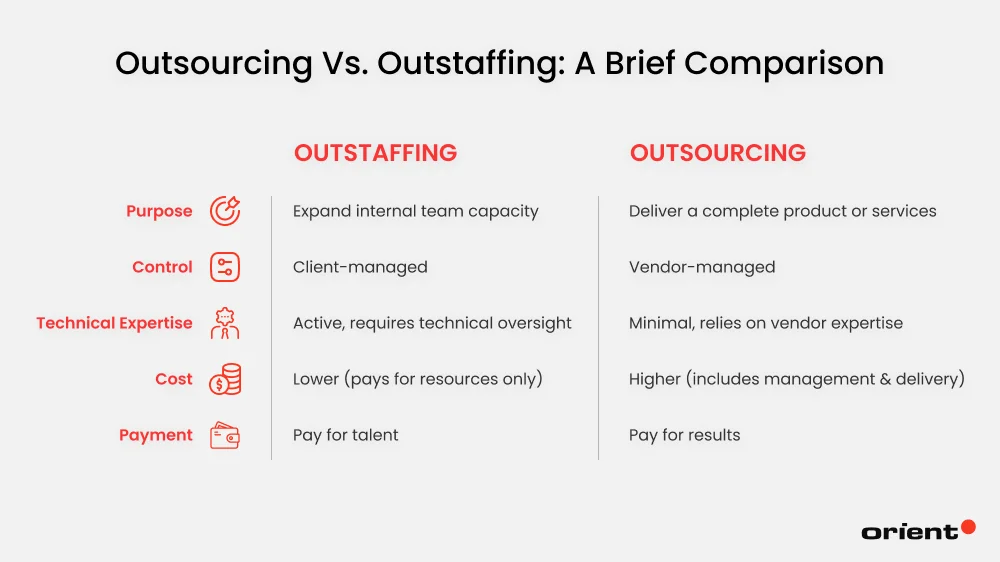
Purpose
Outstaffing, as its name suggests, is primarily about expanding the internal tech workforce by delegating hiring processes to a third party.
Meanwhile, outsourcing refers to a comprehensive solution since its range of services spans from custom software development (including mobile app development, web app development, AI development, etc.) to QA testing rather than only staffing. Based on the project’s scope and requirements, an outsourcing solution can be modified and personalized accordingly.

Different goals naturally lead to different expectations. In the outstaffing model, the objective is to strengthen internal capabilities by integrating external talent or teams into their existing workflows. They expect long-term collaboration, consistent productivity, and seamless communication between internal and external members. In contrast, the focus of outsourcing is on end results. Clients expect an end-to-end product or a specific component without being deeply involved in the software development process or day-to-day management.
In brief, outstaffing aims to enhance internal resources while outsourcing replaces or supplements them through managed services.
Level of Control
As mentioned above, clients retain a high level of control when outstaffing. They manage outstaffed professionals directly, assign tasks, and oversee progress just like what they do with in-house employees. The clients take the lead to ensure full visibility and collaboration. They decide on communication channels and tools as well.

On the other hand, outsourcing involves delegating an entire project or a portion of it to an external provider. The vendor takes full ownership of execution, while the client focuses on high-level oversight. Although clients do not directly supervise the development process, reputable outsourcing partners maintain transparency through regular project progress reports, milestone reviews, and remote coordination practices such as daily stand-ups or sprint demos.
Technical Skills
The level of technical expertise required from the clients also differs between outsourcing and outstaffing.

In an outsourcing arrangement, the clients often give authority to the middlemen and rely entirely on their technical proficiency and experience. Even if the clients lack in-house expertise, it’s fine because the outsourcing company will handle everything, from planning and development to testing and delivery on their behalf and based on the project documentation and objectives provided.
In contrast, outstaffing operates more like a “self-managed” model. Clients are in charge of quality, task alignment, and performance, so they must possess sufficient technical knowledge to guide and supervise augmented developers. Or at least, they have an in-house team to work alongside the outstaffed members. The outstaffing providers only fulfill their role, not touching project implementation and daily workflows.
Cost
Whether it is outstaffing or outsourcing, both are designed to optimize costs. However, the pricing structure and inclusion vary.

Outsourcing includes but is not confined to staffing. Instead, it offers turnkey solutions. For that, the outsourcing arrangement can be more expensive than outstaffing. The outsourcing vendors charge clients for the full scope of services rendered. This amount covers not only developers’ salaries but also project management, delivery, and administrative costs. The total fee varies depending on the pricing model that clients choose from the outset and is specified in the contract. For instance, fixed-price, time-and-materials, or milestone-based.
In outstaffing, overheads are relatively low as clients only pay for what they use. For example, the developers’ time and expertise. The recruitment process and admin expenses can be included or waived, depending on the initial negotiation between the two parties.
Payment Method
Another differentiator lies in the financial relationship between the service users and providers. Specifically, it is how payments are structured and managed.

In outsourcing, the vendor assumes full responsibility for project outcomes, and the client pays for the deliverables. Payment structures in outsourcing usually follow one of these two models:
- Fixed-Price Contracts: A total project fee is determined upfront based on defined scope, requirements, and deadlines. This option provides cost predictability but offers little flexibility if the scope changes.
- Time-and-Materials Contracts: The client pays for the actual time and resources the vendor’s team spends on the project. This approach is more adaptable for evolving projects but may lead to less precise budgeting.
The outstaffing model operates differently. Here, clients spend money on the expertise of professionals, not deliverables. This setup resembles hiring full-timers, except for the fact that you pay the service provider to hire professionals for you. The payment can be:
- Monthly or Hourly-Based: The client pays a recurring fee per professional, which includes the worker’s salary, benefits, and the provider’s service margin. (This structure is widely used.)
- Transparent Cost Structure: The client knows how much each team member earns and what portion goes to the outstaffing company for administrative services. (This structure is less popular.)
In short, outsourcing usually follows a pay-for-results model while outstaffing is a pay-for-talent model.
IT Outstaffing and Outsourcing: Orient Software Excel at Both
At first glance, IT outstaffing and software development outsourcing seem similar. Their shared foundation in external collaboration and support often leads people to use the terms interchangeably. But at the end of the day, they are distinct in essence.
Fortunately, you don’t have to worry too much about drawing a strict line between these two. Most service providers now deliver a comprehensive mix of services and solutions that include both outstaffing and outsourcing models. So, while it is necessary to understand the difference, it is just as important to recognize that the two complement each other.

Orient Software stands as a powerhouse that excels in both outsourcing and outstaffing. Based in Vietnam, we serve as a one-stop partner for worldwide businesses seeking tech solutions and outsourcing services across different models, domains, and technologies. A history of 20+ years in operation, a global team of 350+ professionals, a proven track of 200+ previous clients, and successful projects are only a few of our achievements that define our brand so far.
Whether you require an outsourced team of skilled developers or several teams to scale your projects, our large pool of carefully selected tech talent ensures that all your needs are fully met. Beyond traditional outsourcing, we can build and tailor your remote team or take full ownership of your entire development lifecycle as required.
Diverse experience or solid technical expertise is not our only strength. We take pride in our consulting and customer support services. With a focus on long-term partnerships with clients worldwide, Orient Software delivers results that exceed expectations.
Outstaffing or outsourcing? No matter the choice, Orient Software delivers best-in-class solutions. Tell us about your project, and we will respond within just a few days.

Trung Tran
Technical/Content Writer
Trung Tran
Technical/Content Writer