The development of a mobile app is not a short race; it is a marathon. From design through to implementation, all the processes require time, money, and talent, which most in-house teams cannot afford to recline on. Where the salaries of software developers are still increasing with the high labor expenses or harsh job-seeking rules, business owners are presented with an impossible choice: grow rapidly or remain afloat.
This is why outsourcing mobile app development turned out to be the strategy of choice several decades ago. It has not only overcome cost differences but also provided access to talent around the world and ensured the continued movement of outsourcing mobile app projects where the local team would fail. But as the world grew more and more interdependent, fissures started appearing. The difference in time zones slowed communication, whereas the cultural gap had a silent influence on speed and quality. What initially held out for efficiency began to show its shortcomings.
The current evolution has assumed a new form today. It maintains the advantages of outsourcing while uniting teams in terms of geographic location, culture, and cooperation. Besides minimizing the development costs, this nearshore model also reconnects, regulates, and reinstates clarity to the manner in which the modern apps are developed. Welcome to nearshore mobile app development, a new world of proximity as the new performance advantage.
What Is Nearshore Mobile App Development?

Nearshore is a term that is used to signify the strategy of working with a software development team in a neighboring nation, that is, one to three time zones from your headquarters. The strategy takes the disadvantage of outsourcing and the advantage of proximity and lets the companies work together while retaining the control of quality and speed.
In simple terms, nearshore mobile app development is a business model that involves a business organization outsourcing part or the entire mobile app development process to a country that is close to it. It is a compromise between the two traditional models: onshore development and offshore development. The major distinction is distance and alignment. The nearshore partners tend to work in the same working hours and have a similar business culture and speak in real time, which is frequently lost in the long-distance outsourcing model.
To illustrate, an American company can collaborate with a nearshore development team in Mexico or Colombia. The European companies tend to partner with representatives of Poland or Romania, and the Korean and Japanese enterprises tend to focus on such destinations in Southeast Asia as Vietnam and Malaysia. The purpose is similar in both cases: it is to get the agility and cost efficiency of outsourcing without distance/time restrictions.
Why Nearshore Is Gaining Popularity?
Increasing Demand for Agile, Collaborative Development
In the present day, product teams are not measured using the cleanliness of their code but the speed with which they can transform an idea into a feature that is delivered to the users. Each release of any app has turned into a live experiment, and each sprint cycle into a race with changes in the market.
However, the best-designed process of Agile methodology fails when distance intervenes. The issue is not time zones, but fragmentation. The product ceases to learn at a pace sufficient when design, development, and testing are in silos that are geographically and time-wise apart. Feedback becomes backlog, and the impetus gradually dies away.
Right there, nearshore mobile app development aligns with the emerging reality of software delivery. It isn’t simply to trim down costs but to maintain flow. The companies can maintain the creative pace with which Agile was designed: constant communication, a common environment, and rapid and evidence-based iteration by co-locating distributed nearshore development teams.
Time Zone Alignment and Cultural Compatibility
The majority of teams are already aware of the fundamentals: time zone differences slow down the project, and communication will be more difficult due to the cultural differences. Delay is not the actual price of distance, but it’s the disconnection. Any hour that elapses between posing a question and the answer interferes with the intellectual flow that propels problem-solving. Each misunderstood intonation or lost nuance eats up trust, turning work into an automated process rather than a creative one.
Nearshore mobile app development eliminates that invisible lag between idea and action. When teams not only share working hours but also working rhythm, context doesn’t have to be reloaded every morning. Decision-making becomes streamlined, innovation becomes challenging, and responsibility becomes natural.
A programmer in Vietnam or Poland can possibly work on usability or localization in a different way than a programmer in Japan or the U.S. can, which can tell us things that internal teams may never observe. Such multiplicity of thought contributes to the products being more natural in the markets and hence not just being well constructed but also relevant in a broad spectrum.
Key Benefits of Nearshore Mobile App Development
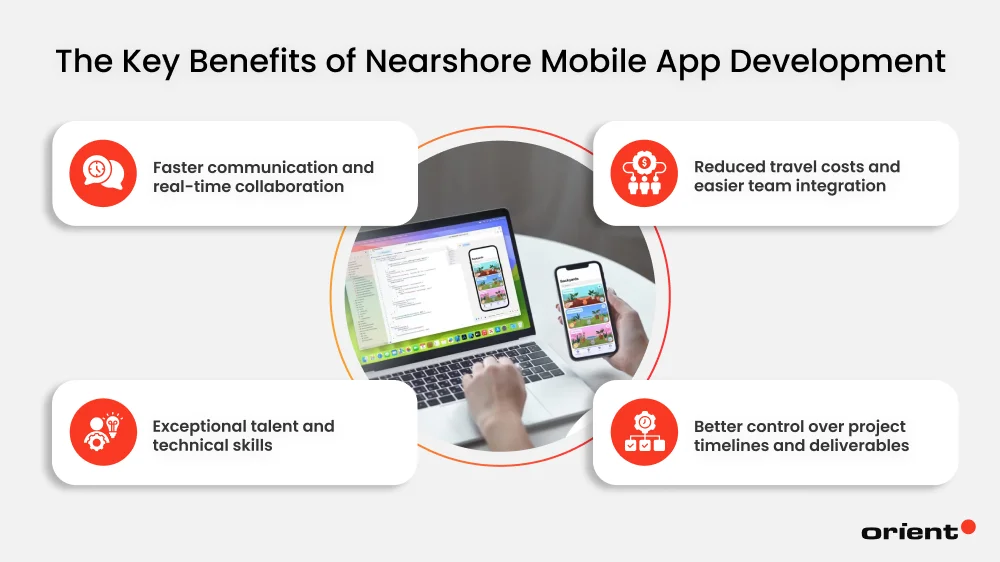
Faster communication and real-time collaboration: When teams of developers are not separated by time zone, they have removed the most significant obstacle: waiting. Problems are solved immediately and keep the workflows moving, reducing the feedback cycles and accelerating the time-to-market. In addition to efficiency, this time zone alignment improves the level of collaboration. The teams develop with greater ease, and there is a sense of ownership as opposed to strict protocols. The common ground triggers the creativity that makes the ideas develop dynamically, and the collaboration turns into a real force of innovation.
Reduced travel costs and easier team integration: Nearshoring eliminates the sticker shock of international flights and hotel accommodation expenses of such critical kickoffs, workshops, or user acceptance testing sessions. It makes in-person collaboration feel like a quick hop rather than a logistical nightmare. It’s the apparent victory: the teams are easier to integrate, the trust is established naturally, and the agile sprints go through without the weight of video calls.
Exceptional talent and technical skills: Onshore talent hunts are costly in both time and budget, and they are the specialists who come at a premium, forcing a group to work with half-baked code. Nearshoring reverses this: an off-the-shelf pool of nearshore mobile app developers in React Native or SwiftUI, which will produce scalable applications in a flash at low cost, and never rely on endless job interviews.
Better control over project timelines and deliverables: Nearshoring is a direct response to delays in projects and low quality of project performance due to time zone disparities. It creates a 1-3 hour working overlap such that instant check-ins are possible, whereby applications are delivered in time, of high quality, and scalable. The main strength is proactive cadence. These joint working hours make passive supervision active, enabling teams to identify and address cascading risks, including a change in the UI affecting the API, during live and collaborative review. This ability to avoid risks in the beginning has a great effect on efficiency and causes significant savings in costs.
Nearshore vs. Offshore vs. Onshore: A Comparative Breakdown
In order to get an idea of the worth of nearshoring, it is better to consider its position in the range of other outsourcing models.
- Onshore development refers to recruiting teams in-country. Communicating is easy, but the expenses involved tend to be the highest, particularly in countries that have strict labor laws and high developer salaries.
- Offshore development refers to the work with the team that is situated some distance away, even continents apart. Although the cost advantage is high, non-overlapping time zones, language barriers, and differences in business practices can slow down collaboration.
- Nearshore development is in the middle ground. The teams are sufficiently near that they are able to share working hours, visit each other more easily, and communicate more easily, but at the same time can grow in a sustainable manner.
| Model | Location Proximity | Cost Efficiency | Communication Ease | Talent Access | Time Zone Alignment |
|---|
| Onshore | High (Domestic teams, easy visits) | Low (Premium rates, no savings) | High (Shared culture/language) | Limited (Talent shortages, high competition) | Perfect (Identical hours) |
| Nearshore | Medium (1-4 hour flights, regional hubs) | Medium-High (30-70% savings vs. onshore) | High (Cultural affinity, strong English) | Strong (Deep pools in aligned ecosystems) | Good (0-3 hour overlaps) |
| Offshore | Low (Distant continents, visa hurdles) | High (50-70% savings, volume scale) | Low-Medium (Accents, hierarchies add friction) | Strong (Massive global talent) | Poor (8-12 hour gaps) |
Strengths and Trade-Offs by Model in Details
Onshore Outsourcing

Onshore Strengths
Seamless Communication: Everyone knows that sharing the same language and cultural context makes work smoother. Onshore is taking away signal distortion, the silent killer that makes teams slow.
Real-Time Collaboration: Working in the same time zone sounds like a scheduling convenience, yet its real value is the uninterrupted rhythm it creates. Decisions happen within minutes rather than hours.
Easy Oversight and Quality Control: Seeing how your team operates in real time, instead of relying on status reports, gives you a more honest read on the project. This proximity creates a subtle but powerful effect.
Strong Legal and Compliance Alignment: Sharing the same laws, security standards, and intellectual property frameworks does more than reduce risk. Developers make decisions with more confidence because they understand the boundaries they are working within.
Onshore Trade-offs
Most Expensive: Onshore is not cheap, and everybody understands that. However, the real price is higher than the salary. It is also a premium to be competing with Big Tech and VC-backed startups, and a talent market that is being pulled in every direction. It is not just that you are paying for skill. You are paying to keep people.
Limited Talent Pool: When you recruit locally, it might seem safe, but you are actually reducing your potential for innovation. IoT firmware, Rust backend engineering, and AI inference optimization are highly specific skills that may be found scarce on the domestic market or cost much more than is viable.
Scalability Challenges: Onshore team scaling can be likened to the control of a gigantic vessel. It is cumbersome, bulky, and costly. Other models enable the teams to expand or contract with ease, whereas onshore requires you to be bound to a much less flexible staffing structure.
Nearshore Outsourcing

Nearshore Strengths
The benefits of the nearshore model have been discussed in detail in the previous section. Let’s take a look at its trade-offs.
Nearshore Trade-offs
Not the Cheapest: You get a better price with nearshore, but it is not a bargain price. That is intentional. Nearshore is not intended to be entirely cost-cutting. It is aimed at maximizing the investment.
Smaller Talent Pool: Although the company has gone regional, there is not as large a talent pool as can be found offshore globally. There can also be a shortage of highly specialized skills, and a rapid increase in scale over a limited time span can be caught by capacity constraints.
Minor Cultural Differences: There are still some minor differences, such as national holidays, communicative habits, and unspoken assumptions. These discrepancies are simple to control; however, when neglected, they may pose some small dislocation that would influence the project’s pace.
Offshore Outsourcing

Offshore Strengths
Maximum Cost Savings: The majority of businesses refer to the reduction of labor costs by 50% to 70%. The higher interpretation is that offshore gives one the freedom to experiment. Several MVPs, parallel projects, and discovery modules, which would be too costly onshore, can now be made possible.
Vast Talent Pool: Offshore is widening your talent pool and eliminating the boundaries altogether. The model gives you the chance to find the right person with the right skills at the right moment. This ability is a competitive edge of companies that must grow at a high pace.
24/7 Operations: The various time zones are perceived as a challenge. The twist lies in the fact that they may be a multiplier of the speed when used in the right way. The follow-the-sun model ensures that the development process never stalls any individual team.
Offshore Trade-offs
Communication and Time: Time gaps make real-time communication a rare occurrence. The problem with the hours is not the hours per se, but the lack of effective decision-making in the team, which may happen in case the team does not have good processes.
Cultural and Language Barriers: Cultural differences do not normally make every day a nightmare, but a handful of critical misunderstandings may make a sprint go off course. This is an indirect expense that most managers underestimate.
Higher Management Overhead: To be successful, offshore needs clear documentation, well-maintained backlogs, and a modularity of tasks. In the absence of such a structure, any cost advantage can be lost in the management overheads in a short time.
Security and IP Risks: International enforcement of contracts and the protection of data and intellectual property are always more complex. Every jurisdiction is different, with its own rules, and maneuvering is a taxing endeavor.
Harder Travel: It will be much harder to build trust face-to-face. Travel is time-consuming, costly, and physically demanding, and jet lag transforms every trip into a big task.
Popular Nearshore Destinations for Mobile App Development
Nearshoring is a business that favors closeness, physically and mentally. Companies in large technological centers such as the United States, Germany, and Singapore are resorting more to the local countries so as to work with them without necessarily compromising quality. The following breakdown is a comparison of onshore salary base and nearshore developer pay, which can explain why the model is turning into a global default in mobile app development.
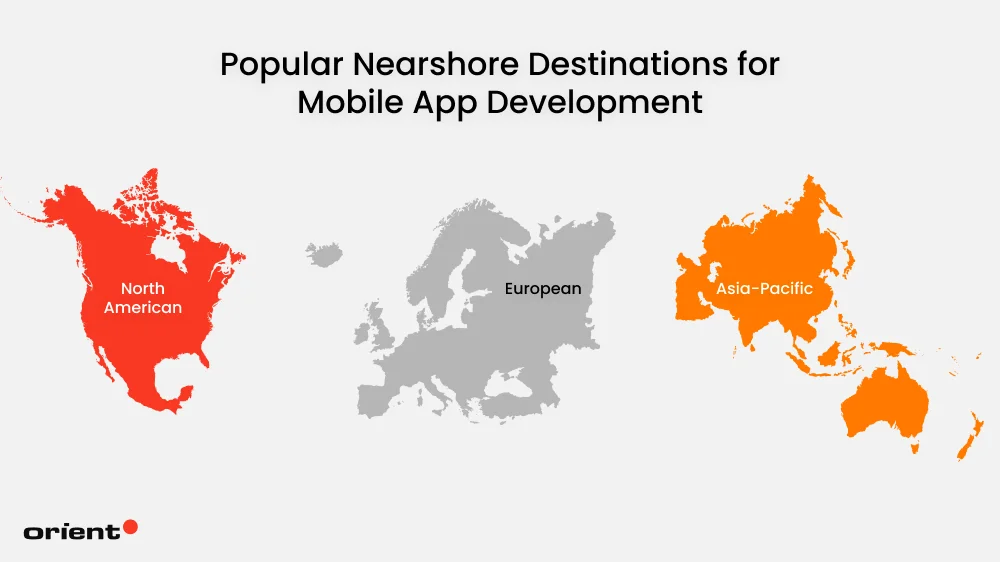
North American Nearshoring: Latin America
To the U.S. companies, Mexico has become the nearshore of choice, where time-zone compatibility is coupled with solid engineering capacity.
- Onshore baseline (U.S.): Glassdoor and ZipRecruiter (2025) report that on average, a mobile developer makes between $105,000to $130,000/year, or approximately $60-80/hour.
- Nearshore comparison:
- Mexico: Average salary around $55,894/year, with hourly rates $25–45 depending on seniority (Howdy, 2025).
- Colombia: $20–35/hour (junior), $35–55/hour (mid), $60–70/hour (senior) (Abbacus Technologies, 2025).
- Brazil: $1,800–8,000/month depending on level (Abbacus Technologies, 2025).
Key takeaway: Nearshore teams in Latin America are providing cost savings of 40%-60% relative to onshore U.S. teams, and they work within a few time zones of Silicon Valley.
European Nearshoring: Eastern Europe
To Western European companies, particularly in Germany and the UK, Eastern Europe is the natural nearshore path.
- Onshore baseline (Germany): Average software/mobile developer earns €70,000–€90,000/year (≈ $75,000–$95,000) (Glassdoor DE, 2025).
- Nearshore comparison (Wild.codes, 2025):
- Poland: $3,200 (junior), $5,800 (mid), $8,500 (senior) per month.
- Ukraine: $2,500 (junior), $4,500 (mid), $7,000 (senior).
- Romania: $2,900 (junior), $4,900 (mid), $7,800 (senior).
- iOS developer annual range: $16K–$65K across these markets (Alcor-BPO, 2025).
Key takeaway: Eastern Europe has a close cultural and linguistic orientation with the EU, providing the best technical education and saving 35%-50% on onshore teams in the West.
Asia-Pacific Nearshoring: Southeast Asia
To firms that have their headquarters in Singapore, Australia, or Japan, Southeast Asia offers a nearshore ecosystem that is agile and cost-effective.
- Onshore baseline (Singapore): Mobile app developers earn SGD 90,000–120,000/year (≈ USD 66,000–88,000), per JobStreet 2025.
- Nearshore comparison:
- Vietnam: $800–4,000/month depending on seniority; hourly rates $15–45/hour (SecondTalent, 2025).
- Malaysia: $8,500–20,200/year depending on experience (FastLane Recruit, 2025).
Key takeaway: The main implication is that in a few hours of flights, Southeast Asian nearshore teams can provide a cost savings of up to 70% with good English-speaking skills and mobile application development skills, especially in cross-platform architectures such as Flutter and React Native.
How to Choose the Right Nearshore Partner
The selection of the appropriate nearshore partner goes beyond cost considerations. The actual objective is to identify a team that is reliable, quick, and efficient in communication. Here is a stepwise method through which companies may take into account and employ a nearshore software development group with certainty.
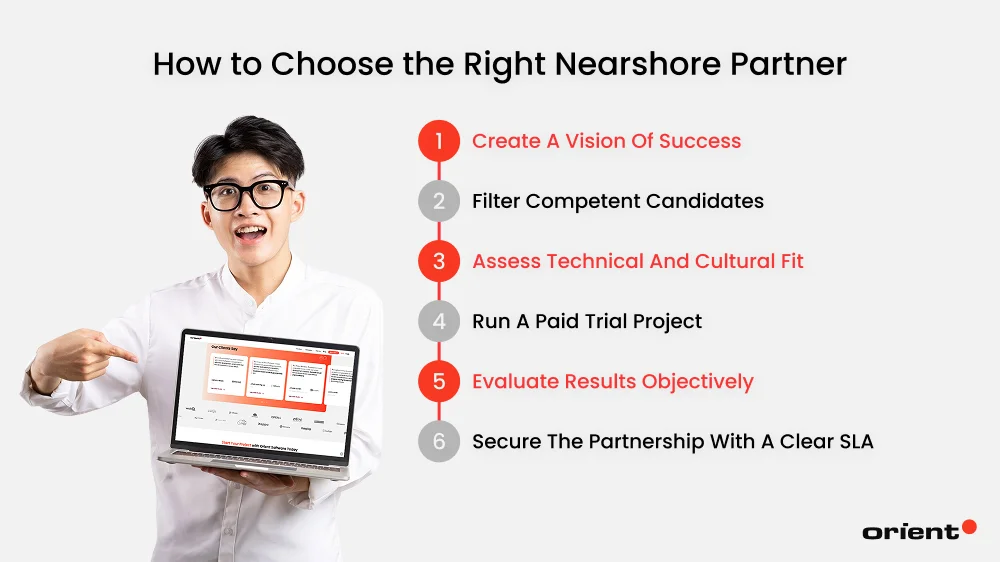
Step 1. Create a Vision of Success
Prior to commencing the assessment of agencies, straighten out your priorities. Consider what is the most important thing to your project: speed, cost efficiency, security, or product quality, etc. An example of this is that compliance and data protection can be prioritized over the fast delivery of a fintech app, but time-to-market can be prioritized by a consumer app. Write these priorities down as a brief project outline that defines your goals, technology stack, and schedule. This paper will be a guide to all the discussions with the prospective vendors.
Step 2. Filter Competent Candidates
Start the sourcing process by using the method of referrals, Clutch, or LinkedIn. Target your search on those teams that have experience in the development of mobile applications that are similar to yours, preferably in the same industry. Being transparent by sharing the profile of the developers or publicly accessible GitHub repositories is something that should be given the first priority, and they should also have working hours that would be compatible with your time. It is aimed at developing a perfect shortlist of five or eight teams, which is ample enough to compare and yet conduct interviews and due diligence.
Step 3. Assess Technical and Cultural Fit
Don’t rely on marketing decks. Request three case studies that include project scope, architecture, and measurements such as load times or retention of users of the project. In interviews, compare both professional skills and the manner of communication. Request a short technical proposal detailing how they would develop one of the most important parts, such as the authentication system of your app or the push notification module. Their reaction time and clarity will say much about their level of maturity in engineering and the pace of their cooperation.
Step 4. Run a Paid Trial Project
The surest method of testing the real performance of a team is by paying for a 2-4-week pilot project. In order to do that, give them one full-fledged and standalone feature, like user onboarding with biometric login and automated tests. You must insist that they hand over a working build on TestFlight or the internal track of the Play Store and submit documented handover notes and commit all of the code to a common repository, including pull request reviews. This micro-project is helpful to demonstrate the way the team manages timelines, communication, and quality in the real world, and to learn some insights that can never be substituted by an interview.
Step 5. Evaluate Results Objectively
Evaluate the outcomes of the team after the trial by means of quantifiable criteria. Also assess their code quality and discipline in the area of testing, and the speed and precision of their milestone delivery. The responsiveness of the former is also important to note and identify a cultural fit between them and the rest of your team. Also, examine their security hygiene, including checking against practices like no hard-coded credentials and proper code reviews. Companies whose scores on these metrics remain high are the best placed to perform well in a long-term engagement.
Step 6. Secure the Partnership with a Clear SLA
After finding the appropriate partner, sign the partnership with a clear agreement. The ownership must be well spelled out in a good Service Level Agreement (SLA), where all the code and intellectual property must be transferred to your company upon payment. It also ought to make tangible promises about response times, like critical bug fixes in 24 hours, mandated security standards, encrypted repositories, role-based access, and a defined warranty time, such as 90 days of free bug fixes post-delivery. In the case of growing startups, a well-developed SLA is a valuable safety net, which keeps everything accountable and allows for cool scaling of the application as it develops.
The choice of the appropriate nearshore partner is not a chance affair. Every process, which includes goal definition, trial, and others, minimizes risk and fosters mutual trust. The outcome is a joint venture that can give them native-level performance, reduced time-to-market, and stable reliability without the expense penalties associated with onshore staffing.
Real-World Examples and Success Stories
The power of nearshore mobile app development becomes tangible when you look at real outcomes. In most of the industries, firms that have selected the appropriate nearshore partner have experienced a reduction in their delivery cycles, cost reduction, and enhanced quality of their products.
Take Orient Software, a leading nearshore software development company in Asia, as an example.
When NTUC, a Singapore-based education technology leader, required updating its large-scale system to be more scalable and performant, the nearshore team of Orient Software in Ho Chi Minh City, Vietnam, became an extension of its operations. Having a time zone gap of only an hour, the team facilitated smooth day-to-day work, fast iterations of microservices and micro-frontends, and the incorporation of mobile enhancements through React Native, with minimal communication latency. The project has shown significant gains in system speed and responsiveness, scalability to accommodate more user demands, and quality code through best practices, simplified workflows, and overall improved efficiency in the operations of a partnership that has continued over four years.
Another example is that Australian fintech innovator Plenti joined forces with Orient to scale its lending system and transform its existing legacy systems to gain a competitive advantage in the consumer finance market. The almost three-hour difference due to the nearshore model made it easier to conduct Agile sprints, real-time issue solving, and collaborative feature development with the use of ReactJS and Angular to create cross-platform experiences. This arrangement guaranteed stringent testing and quality assurance, a 50% speedier implementation procedure, and a well-performing system that can sustain rapid expansion and the efficient interaction of users.
These stories emphasize the effectiveness of nearshore development, which includes close proximity, cultural alignment, and similarity in working hours. The strengths that Orient Software possesses can be used to ensure that partnerships turn out to be long-term successes.
In case you want to deliver faster, reduce expenses, and retain the complete possession of your product roadmap, then the nearshore solutions in Vietnam provided by Orient Software are the right mix. Orient Software has well-established teams that have proficiency in Flutter, React Native, and Kotlin Multiplatform to develop world-renowned mobile experiences without the hassle of a distant outsourcing company. Start your new mobile application with Orient Software and get faster, closer, and better development.