
Flutter Alternatives That Are Gaining Popularity Among Developers
Flutter has truly captivated us with its shiny widgets and hot reload magic, but does the promise of “write once, run anywhere” quietly undermine your project’s performance, native experience, or team efficiency? We will evaluate the Flutter alternatives that are rapidly gaining popularity among developers and provide you with an expert cheat sheet to help you switch frameworks with minimal regrets.

Content Map
More chaptersOver the past few years, Flutter has stood as the flagship of cross-platform mobile development, promising developers the ability to “write once, run anywhere” across iOS and Android apps. Its cohesive utility toolkit, smooth hot reload, and almost native appearance attracted enormous numbers to its user base in the developer community. However, with the growth of the cross-platform development space: desktop apps, web-based technologies, and integration of native device features, the previously unmatched role of Flutter is beginning to shake.
This evolution has prompted many engineering teams to reassess their toolchains: is Flutter still the most optimal framework, or is it time to explore other cross-platform frameworks that better align with modern scalability and multi-platform demands?
In the Stack Overflow Developer Survey 2024, under the “Other frameworks and libraries category” (which is a category that includes many popular cross-platform app development tools), Flutter has a 9.4% result with all respondents and 9.0% with professional developers. In comparison to the past surveys, Flutter had nearly 12.6% in 2022 and 9.1% in 2023, and it is possible that its initial popularity boom has already entered its plateau. Flutter no longer seems to be in the same rapid expansion of its early years, but seems to be in a more mature phase in the wider cross-platform development environment.
This deceleration is not fatigue, but it is a change of priorities of the developers in an emerging mobile app ecosystem that has now traversed both web technologies and desktop apps, as well as native device capabilities, without sacrificing speed or scalability. The rich JavaScript ecosystem of React Native, the shared business logic of Kotlin Multiplatform, and other cross-platform frameworks are becoming widely studied by developers to enable their teams to create a truly native app that is closely integrated into platform-specific APIs. This guide cuts through the noise to show you the new technologies that developers are flocking to. We look at the growth of declarative, compile-to-native, and web-based solutions and give you a clear guide on when to use Flutter alternatives.
Why Look Beyond Flutter?
The architecture of Flutter and the Skia renderer are efficient in iOS and Android UI prototyping and can allow a small group of people to create beautiful applications with little to no boilerplate. However, as the projects grow, constraints start coming into play, which can weaken their cross-platform promise.
Performance is one of the areas of concern: With the increase in project complexity (e-commerce dashboards, AR tours, multi-platform targets), the custom rendering path that Flutter follows could need additional tuning to ensure high frame rates and responsiveness.
Although Flutter encourages a cross-platform codebase, platform integration is still a problem. As an example, the requirement to use platform channels to exchange messages between Dart and native Swift/Kotlin adds extra complexity and custom implementation. In addition, in a survey of Flutter developers, approximately 24.5% claimed that the Dart tools became significantly slower when their Flutter project increased, and 16.7% claimed that the slowdown affected productivity with a strong negative influence.
Further, wider industry data indicate that over fifty percent of mobile developers are already using cross-platform frameworks with the prospect of targeting both Android and iOS using the same code base, indicating that any pain in reuse or native integration would be a strategic issue.
These observations do not imply that Flutter is inappropriate; on the contrary. They are suggesting that in the case of your project, where it isn’t just a simple mobile application but a more general cross-platform development case (mobile + web + desktop + native device features), there are more intricate trade-offs. It is no longer about the possibility of creating mobile applications within a short period of time and selecting the appropriate framework; it is about scalability, native performance, and integration.
In that regard, considering alternatives to Flutter is not a failure but is a strategic fit: such tools as frameworks on top of established ecosystems, or that go more like single-platform native code, can have less friction when the requirements extend beyond mobile.
Key Criteria for Choosing a Flutter Alternative
The choice of a Flutter alternative is not about pursuing the most glittering new cross-platform framework, but basing your choice on the realities of long-term mobile development as understood but never discussed. The right tool is not only the one that makes the builds faster today, but also one that can be scaled on multiple platforms and does not require the technical debt to be accrued.
In order to make decisions, prioritize the following interdependent pillars that show how each model of building mobile apps can withstand the test of time:
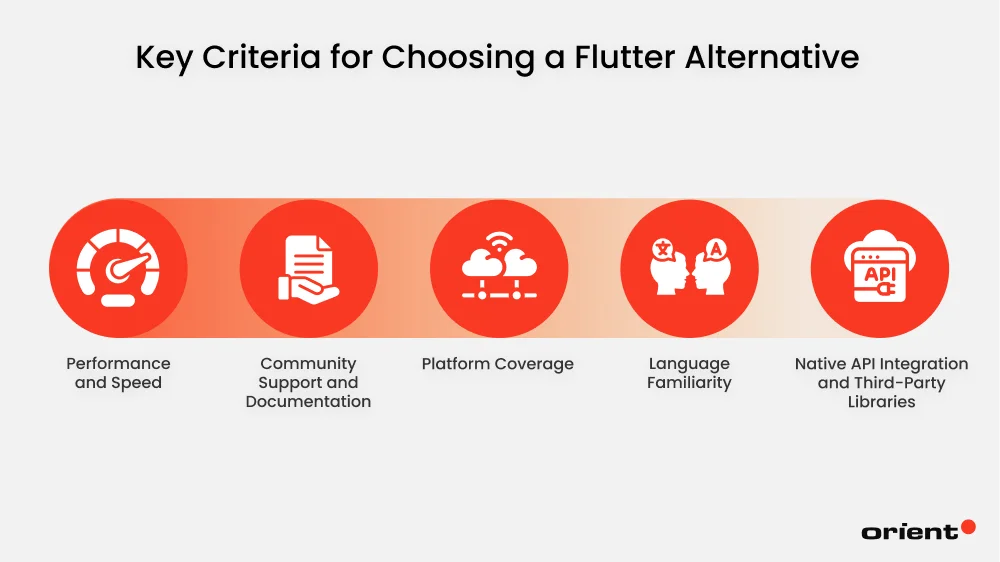
Performance and Speed: In cross-platform mobile applications, latency problems, however minor, kill user interaction. According to Google, half of the users give up on slow mobile apps in a few seconds. Prefer cross-platform frameworks, which either use native rendering or lightweight bridges to avoid the rendering overhead of Flutter, to achieve frame rates under 16 milliseconds, at least, to avoid the impact of native performance and smooth animations. Do not benchmark vendors! Do your tests in Android Studio or on simulated traffic spikes to verify that it is responsive without compromising on the ability to control native code or business logic.
Community Support and Documentation: A strong developer community will turn into short-term wins on the potential roadblocks. Measures such as GitHub stars, activity in Stack Overflow, and repo velocity are your compass. A healthy ecosystem is one where you never have to debug in the dark.
Platform Coverage: The modern cross-platform architectures are expanding way beyond the traditional iOS and Android scope. The modern ecosystem now includes desktop software (Windows, macOS, and Linux), progressive web apps (PWAs), and embedded software or IoT devices on smart displays, wearables, and automotive systems. Others are even able to share business logic and common UI layers to reuse code across mobile, web, and desktop, but take advantage of platform-specific APIs to provide native performance.
Language Familiarity: This is one of the main factors of productivity and project lifespan in cross-platform development. Developers who use common languages like JavaScript, TypeScript, Kotlin, or C# will be transitioning at a quicker rate, generate fewer errors, and work more efficiently across various teams. Also enabled by this alignment is access to already existing ecosystems, enabling teams to reuse libraries, tools, and common business logic without always necessarily rewriting them.
Native API Integration and Third-Party Libraries: The most appropriate frameworks enable developers to access the native device capabilities, including biometrics, sensors, and cameras, directly without using a complicated bridging layer or workaround. This is such a strong integration that apps perform at the native level, have a consistent user interface behavior, and are compatible with the most important SDKs and system services. A framework that enables a smooth interaction with platform-specific APIs not only improves the user experience but also simplifies the entire development process, feature implementation, and long-term maintenance.
Top Flutter Alternatives
React Native

React Native is the standard of UI-rich, cross-platform applications, honed over a decade of development by Meta and powered by JavaScript. It is based on native UI components, including iOS with the Skia engine and Android with Views, and it provides true native animations, gestures, and responsiveness without the rendering idiosyncrasy and is compatible with platform APIs.
JavaScript universalism enables groups to reuse a maximum of 70% of web expertise, cutting onboarding, expenses, and upkeep. The NPM package repository hosts more than two million packages and offers tens of billions of downloads per week, and an active community includes libraries for any task, with such tools as Expo and Reanimated 3 to introduce innovations with a strong performance profile.
Most flexible, React Native can be seamlessly integrated with legacy native apps (as opposed to the full rewrite of Flutter), which allows enterprises to upgrade their apps over time, reduce risk in transitions, and incrementally scale. It is not only competing with Flutter but is also fulfilling the maximum promise of cross-platform development with a mature tooling system and with support of a strong community.
Xamarin / .NET MAUI
In the case of Microsoft-centric companies, the successor of Xamarin, .NET MAUI, provides a strategic advantage, as it is built upon a well-known platform like C# and .NET, and thus, can unite the backend, APIs, and mobile applications, unlike Flutter, which erects barriers around Dart.
The Visual Studio integration is a way to bring the pro tools, such as IntelliSense, debugging, profiling, and CI/CD, and make shipping faster with fewer bugs, which is important in regulated industries such as fintech and healthcare. It includes iOS, Android, macOS, and Windows without stack refinement.
Azure connections visualize workflows: Direct entry to secure authentication (Azure AD), analytics (App Insights), and storage (Cosmos DB), avoiding third-party extensions to lower the maintenance chances due to Flutter. Shared business logic in MAUI is matched with native UIs, giving scalable consistency, putting predictability and security over aesthetic appearance.
In the case of .NET stores, it is not only a Flutter alternative but also an ecosystem development that builds up the entire software mindset.
Kotlin Multiplatform
Kotlin Multiplatform (KMP) reinvents cross-platform development, sharing business logic written in Kotlin but maintaining native UIs in each platform (i.e., Android, iOS, desktop, and web apps), and they can be authentic native applications without Flutter’s homogenous widget set. Compiling to platform binaries (Kotlin/JVM on Android, Kotlin/Native on iOS, and Compose Multiplatform on desktop/web) provides granular control to teams: compilation is as efficient and responsive as pure native code, and it can be relaxed to achieve additional goals like code interoperability.
Being a Flutter alternative, KMP easily fits into Kotlin/Java platforms and does not require retraining Android Studio developers. It provides 60% code reuse, reduced maintenance, and faster implementation of complicated applications such as fintech or logistics that require deep native access to APIs.
It is culturally friendly to Android-iOS interaction, as it does not isolate as Dart does. iOS tooling is becoming more mature, whereas KMP focuses on native scalability and less on UI abstraction, creating apps that are foundationally sound.
NativeScript
NativeScript provides the cross-platform vision of a purist: it has direct access to native API through JavaScript or TypeScript and does not go through the rendering engine of Flutter or bridges to real-time updates and instant ability of SDK compatibility.
Apps with a heavy hardware requirement can work well here, including smooth calls to the camera, Bluetooth, or sensors; no plugin is required to catch up, and there is consistent performance even when the resource usage is high, without the Flutter Dart mastery barrier. It bridges the gap between web and native apps, using declarative UI (CSS styling, XML layouts) and needing no plugin to keep up, and also performs well when the usage of resources is high, with no Flutter Dart mastery curve.
Its JS ecosystem is smaller than that of React Native, but NativeScript has targeted plugins, and the open-source freedom of choice allows direct native library access, which drives fast prototyping and debt-free start-up and indie codebases. It is unobtrusive but intense; it does not require a bloatware engine. Native-grade apps only require smart and bare access.
Unity (for game-like or 3D apps)
As a game engine, Unity is now the foundation of immersive cross-platform mobile applications using C# with its visual editor, allowing dynamic AR store demos or architectural visuals, medical simulators, or metaverse spaces created with a single codebase and visible on iOS, Android, and desktop.
Unlike the replication of a UI in Flutter, the Unity runtime can provide physics, lighting, and motion on a native level, which cannot be replicated by traditional tools, making it perfect for sensor/camera-driven AR experiences.
Its ecosystem combines gaming and business tools: lean assets, performance profilers, and shared editors make it easier to create complex builds. It is used in sectors such as education, automotive, and real estate to perform simulations that are rich in data and have 70-80% of code reuse.
It is not a general Flutter tradeoff. Unity is where experience is more important than efficiency, a level of apps raised by immersion.
Capacitor / Ionic
The Ionic team, Capacitor, is an advocate of web-first cross-platform development: wrapping existing HTML, CSS, and JavaScript in a thin native shell to create single native iOS and Android apps in weeks and expanding web stacks in weeks with a single codebase. It has direct native API access, camera, geolocation, and PWAs to deploy hybrids without rewrites, without making Flutter load its heavy rendering engine, instead favoring leaner and faster-focused builds.
This is further enhanced by Ionic, which enables front-end developers to create apps with a native feel without using new languages or steep curves, regardless of whether they are a startup building MVPs or a company building dashboards. It is fast in terms of iterations, reduces maintenance, and minimizes debt with smooth plugins.
Although it does not outperform Flutter or React Native in graphics performance, Capacitor is agile when it comes to teams focused on the browser-driven model-to-reality, with production-ready apps on mobile, desktop, and web, and their upward or downward scaling with ease.
Comparison Table: Flutter vs. Alternatives
| Framework | Language | Platforms Supported | Performance | Community Support | Best for |
|---|---|---|---|---|---|
| Flutter | Dart | iOS, Android, Web | High | Strong | UI-rich apps |
| React Native | JavaScript | iOS, Android | Medium | Very Strong | Web developers |
| Xamarin/.NET MAUI | C# | iOS, Android, Windows | Medium | Strong | Enterprise apps |
| Kotlin Multiplatform | Kotlin | iOS, Android, Desktop | High | Growing | Android-first teams |
| NativeScript | JS/TS | iOS, Android | High | Moderate | Native API access |
| Unity | C# | iOS, Android, Desktop, Web | High | Very Strong | Game-like or 3D apps |
| Ionic/Capacitor | JS/TS | iOS, Android, Web | Low-Medium | Strong | Web-first apps |
Emerging Frameworks to Watch
As cross-platform development fragments further, niche players are carving unexpected lanes.
Tauri
It is a redefinition of cross-platform efficiency based on Rust. Its desktop web hybrids boot down to binaries less than 600 KB (a quarter the size of Flutter) that are perfect in security-sensitive, offline-first apps such as dashboards or privacy tools. Tauri can be fast (almost) without Flutter’s overhead of rendering with web technology (HTML, JS, CSS) and Rust, which has memory safety.
According to developers, the cold start is 3x faster, and the security is stronger using Rust’s borrow checker. In the context of developing low-latency, tamper-proof applications, including fintech and IoT, Tauri has 200+ plugins, so integrating hardware is a one-liner, and complex Flutter bridges can be made into a single deployment.
Compose Multiplatform
Compose Multiplatform, a Kotlin-based UI toolkit at JetBrains, is used to hasten the convergence of iOS and desktop apps using declarative, natively rendered UIs, bypassing the Dart limitations of Flutter. It is a part of Kotlin Multiplatform, where shared code is compiled to platform renderers (SwiftUI, Jetpack Compose) to create pixel-perfect images and 60 fps animations, and runs with 20% of the battery consumption of Skia.
It maximizes reuse: 80% shared UI with complex layouts, supported by Kotlin coroutines to easily perform async operations. It is best with Android-dominated application teams that are going to iOS/desktop, where consistency is assured, such as in regulated markets, such as healthcare, and is more realistic instead of approximated like Flutter.
Expo (React Native ecosystem)
Expo is a React Native application that simplifies quicker iteration development in mobile applications. Its OTA updates apply instant updates and fixes instantly to apps without resubmission to the App Store and reduce weeks-long release intervals down to hours, abstracting native modules such as cameras, maps, and notifications, eliminating pubspec setup barriers in Flutter to run continuous deployment of continuously updated apps in 2025. JavaScript’s origins in npm have an expansive set of integrations to facilitate seamless integration of things, such as AI through TensorFlow.js, and it is not as isolated as Dart.
The simulator at Expo Go enhances testing with device previews and the development of a booming cadence of shipping small and shipping often, which is larger than hot reload at Flutter in scale. In the case of web-savvy teams working on e-commerce, social, or lifestyle applications, Expo has turned the dynamic power of React Native into a full-stack productivity engine, introducing modern mobile velocity.
These are not mainstream yet, but the 2025 momentum of them, skyrocketing downloads, and shoutouts at conferences show that someday, specialization will win over generality, and you will have the ability to cherry-pick the tools that maximize your own benefits and do not hide your own weaknesses.
How to Choose the Right Flutter Alternative
To switch or avoid a popular technology such as Flutter, it takes a high level of strategic planning, not just a preference to use glossy new technology. The option should fully match your company’s objectives, personnel strengths, and vision.
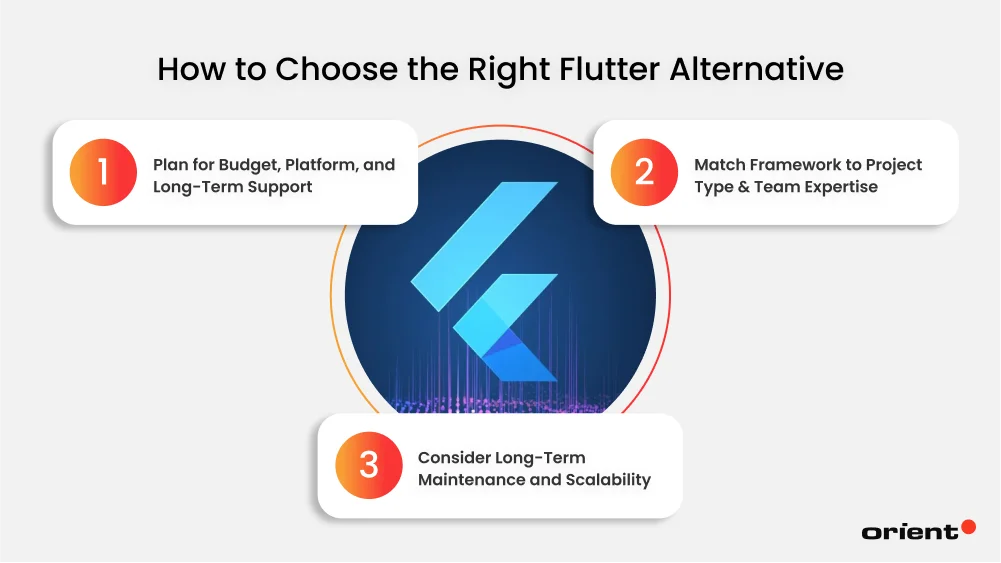
Checklist: Budget, Target Platforms, and Long-Term Support
Budget: Some alternatives to Flutter may require paid licenses, enterprise support, or specialized talent, which can increase development costs. Open-source options like React Native or Kotlin Multiplatform may offer cost-effective solutions, but they vary in terms of tooling and community support. Moreover, your budget will determine the talent pools available. You should evaluate the overall cost of ownership, including the training time of the selected tool.
Target Platforms: Although Flutter is excellent when it comes to writing once and running everywhere, a variety of recent offerings have been found to have better native platforms or web access. In case the development of a unified mobile and web experience is a higher priority for you, a framework such as Ionic or a more modern React Native stack can be less challenging to integrate with your existing web presence. In the event, though, that high performance and intense API accessibility on iOS and Android alone are the key factors to consider, then KMM or pure native development is the best choice, as it guarantees an excellent user experience on niche mobile functionality such as biometric security or high-quality animations.
Community and Long-Term Support: A vibrant developer community ensures access to libraries, plugins, and troubleshooting resources. Frameworks backed by large tech companies like React Native (Meta) or Xamarin (.NET by Microsoft) tend to have more consistent updates and long-term viability. Evaluate the framework’s release cadence, documentation quality, and roadmap to ensure it aligns with your project’s lifecycle.
Matching Framework to Project Type and Team Expertise
The most important aspect of choosing the framework is the ability to fit the particularities of your project and the level of skills that your development team is characterized by.
Project Type vs. Framework Strength:
- High-Abstraction/Utility Apps: Applications dedicated to data presentation, forms, and simple user interaction (e.g., internal tools, simple e-commerce) can perform well on high-abstraction solutions such as React Native with Expo, where speed of development is the focus.
- High-performance/gaming/AR/VR: In projects that need sub-milliseconds of responsiveness or direct access to hardware, one would prefer a more Kotlin-like Multiplatform Mobile (KMM), which is a more sensible choice. The options are much lower in latency and less reliant on a JavaScript bridge.
- Web/Desktop Continuity: In case the mobile app is an extension of a full-fledged web application, the shared language and library ecosystem (React on the web and React Native on mobile) gives the application considerable code reuse and streamlines the learning curve of full-stack developers.
Team Expertise and Learning Overhead: The cost of context switching cannot be underrated. Assuming that your current team already knows TypeScript, transitioning to a JavaScript-based replacement is cheaper and quicker than investing in an entirely new language like Dart, particularly when the team already has experience with the declarative UIs (the same team has experience with React Web or Vue). The successful transition is not only determined by the technical virtues of the framework but also by whether it will be easily adopted by the people who will sustain it in the next five years.
Long-Term Maintenance and Scalability Considerations
A framework decision is a decade-long commitment. The final decision should be made based on scalability and maintenance strategies.
The Cost of Maintenance: Technologies based on complex bridges or external libraries are more expensive to maintain. Each significant OS release (iOS or Android) poses a threat to break those dependencies, and it is only through a substantial engineering effort that they can be repaired. Other options, such as KMM, are able to abstract most of the underlying native code, although native-level knowledge is still needed to debug it thoroughly. Frameworks permitting over-the-air (OTA) updates, like those offered by the Expo ecosystem to a React Native app, can save the lifecycle cost of major releases and hot patches considerably by circumventing the process of submitting an application to the app store with every small change.
Architectural Longevity: Select a model that promotes a clean separation of concerns and promotes modularity. Native-first (or highly adaptable regarding the use of native modules) frameworks also tend to encourage longer-term scalability since they can shift performance-sensitive application code to the standard toolchain of the platform without necessitating a complete application rewrite. This is what makes this architecture flexible enough to make sure that your mobile application does not slow down or crash when it gets more complex.
Final Suggestion

Whilst Flutter constrained a period of cross-platform stability, the future belongs to those that can do a better combination of native performance and fine-grained reactivity, as well as reduce boilerplate by a significant margin: either by using the surgical precision of Kotlin Multiplatform Mobile, the declarative simplicity of SolidJS, or the zero-JavaScript efficiency of an Astro/Qwik hybrid.
The most important point to learn is: there cannot be a single best alternative to Flutter, but one that will fit best to your business needs and the limitations of your team. We highly recommend that technical leaders go outside the vendor lock-in and invest in rigorous internal proof-of-concepts (PoCs), which test new architecture against the actual bottlenecks in the relevant performance of their existing applications, build time, and maintenance costs. Not the most popular tool, but the most architecturally resilient tool will make your next mobile project successful.
It takes a variety of multi-dimensional knowledge to navigate this quickly evolving environment between Dart and Flutter and native-first compilers, JavaScript-written signals, and the new generation build systems. When your internal team is already overstretched or simply lacks the necessary specialized expertise in the full range of developing technologies, the most effective course of action is to engage an established development partner.
Orient Software retains a solid mastery of the entire spectrum of programming languages and frameworks, including React Native and Xamarin, Swift, Kotlin, and more. Regardless of the type of app you need to develop on a mobile platform, the redesign of a web platform, or the expansion of a cross-platform solution, Orient Software can provide custom development work that blends technical and strategic understanding. Ready to take the next step? Get in touch with Orient Software and make your vision of an app a reality with certainty and clarity.